With the Peasants of Aragon. Libertarian Communism in the Liberated Areas by Augustin Souchy Bauer
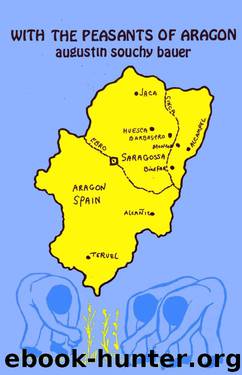
Author:Augustin Souchy Bauer
Language: eng
Format: mobi
Publisher: ChristieBooks
Published: 2013-01-06T02:00:00+00:00
Mazaleón
After July 19th the CNT-FAI Committee in Tortosa invited the people to respect all art objects and to bring them to the Committee. They established a museum with the collection. The anarchists and libertarian youth in many cities and towns in Spain were the protectors of the cultural riches in their communities. Abroad, Spanish workers and peasants, and especially the anarchists, were characterised as barbarians, destroyers of all cultural life.
A town on a mountain ridge, dominated by the church built centuries ago as an expression of collective life. The peasants went to church as a place to meet where they were all united by a common idea. All of them had the same concerns, the same aspirations, and the same cultural conception: the instinct of race, the sense of a universal order in the work induced the peasants to make a collective effort to build the church.
Things have not changed at Mazaleón up to now. The spirit remains the same; the form has changed. The mysticism of the Catholic Church is no longer there. The priests have disappeared. But the peasants do not work to destroy this Gothic building that majestically crowns the peak of the mountain. They have transformed it into a cafe and a lookout site; a nice place to have meetings. They have modernised the buildings and installed loud speakers. They do not meet there Sunday mornings for prayer. Now they meet Sunday afternoons in their collective house under the high Gothic arched roof. The comrades are positivists: they want to enjoy life and nature. They have opened wide the windows of the church. They have set up a large gallery where the altar once stood. The view embraces the southern slope of the Aragón Mountains; a setting of tranquillity, reflection. Neighbours gather there on Sunday, take their coffee and enjoy the calm of the afternoon.
Belief in nature has taken the place of religion, which has been banished. Something more noble has been born: the belief in man and his collective. This is the religion of the Mazaleón peasants today. Everything is collectivised here. Collectivisation was voted unanimously. The teachers also belong to the collective, although they are paid by the State that is not part of the economic community of the town.
“What do you think of collectivisation?”
Bautista Domingo, schoolteacher, socialist and in disagreement with the anarchist ideology and movement, replies:
“I regard collectivisation as great progress. I have been living in collectivised towns for several months. The peasants are better off, production has increased, labour has improved the spirit and solidarity is stronger.”
The president of the town collective, Manuel Aranda, had an original idea. He proposed a system of coupons as a substitute for money. His proposal was accepted.
A book of coupons has a value of 25 pesetas. This money is not distributed as wages: it is used solely as a medium of exchange. Every member of the collective receives a book of coupons. He can buy what he needs from the collective's stores; one peseta per day for adults, 75 centimos for minors under 14 years of age.
Download
This site does not store any files on its server. We only index and link to content provided by other sites. Please contact the content providers to delete copyright contents if any and email us, we'll remove relevant links or contents immediately.
| Africa | Americas |
| Arctic & Antarctica | Asia |
| Australia & Oceania | Europe |
| Middle East | Russia |
| United States | World |
| Ancient Civilizations | Military |
| Historical Study & Educational Resources |
Room 212 by Kate Stewart(5130)
The Crown by Robert Lacey(4821)
Endurance: Shackleton's Incredible Voyage by Alfred Lansing(4790)
The Iron Duke by The Iron Duke(4367)
The Rape of Nanking by Iris Chang(4224)
Joan of Arc by Mary Gordon(4119)
Killing England by Bill O'Reilly(4008)
Say Nothing by Patrick Radden Keefe(3992)
I'll Give You the Sun by Jandy Nelson(3452)
Shadow of Night by Deborah Harkness(3377)
Hitler's Monsters by Eric Kurlander(3352)
Mary, Queen of Scots, and the Murder of Lord Darnley by Alison Weir(3216)
Blood and Sand by Alex Von Tunzelmann(3207)
Eleanor & Park by Rainbow Rowell(3185)
Darkest Hour by Anthony McCarten(3137)
Margaret Thatcher: The Autobiography by Thatcher Margaret(3087)
Book of Life by Deborah Harkness(2943)
Red Famine: Stalin's War on Ukraine by Anne Applebaum(2940)
The One Memory of Flora Banks by Emily Barr(2871)
